Conference interpreting and audiovisual translation
As an interpreter, I work at conferences, seminars and meetings in legal and corporate settings and in technology and innovation, as well as at academic and educational events.
For audiovisual translation, I record in-vision Libras translations of institutional, corporate and educational videos in my own studio.
I have interpreted at events held by organisations including the UN, ETSI (the European Telecommunications Standards Institute) and WASLI (the World Association of Sign Language Interpreters).
Working languages
| Language pair | Direction |
|---|---|
| English and Libras | Both directions |
| Portuguese and Libras | Both directions |
| Portuguese and English | Both directions |
| Spanish and Libras | From Spanish into Libras |
I work directly between English and Libras, with no relay through Portuguese. In the classification used in conference interpreting, Portuguese is my A language (mother tongue), Libras and English are my B languages (which I also interpret into) and Spanish is my C language (which I interpret from).
Formats
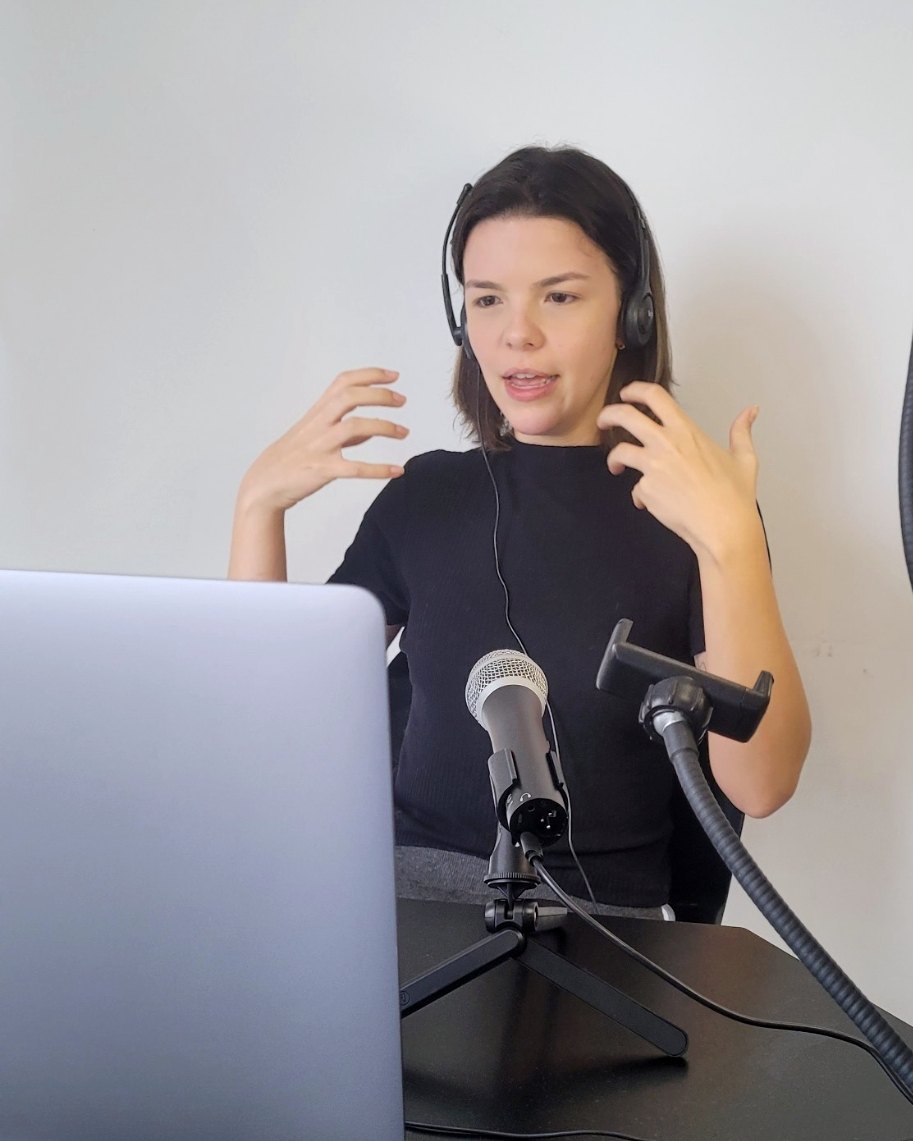
Simultaneous interpreting can be provided in person or remotely. The format determines the team, the equipment and the preparation required.
In person
On stage or in the booth.
Remote simultaneous interpreting
By videoconference, with interpreters and participants in different locations. The platform, audio and framing need to be tested beforehand.
Hybrid
Part of the audience in the room and part online, with Libras visible to both.
Live streaming
In-vision interpreting, in an on-screen window, for events streamed online.
Audiovisual translation and studio
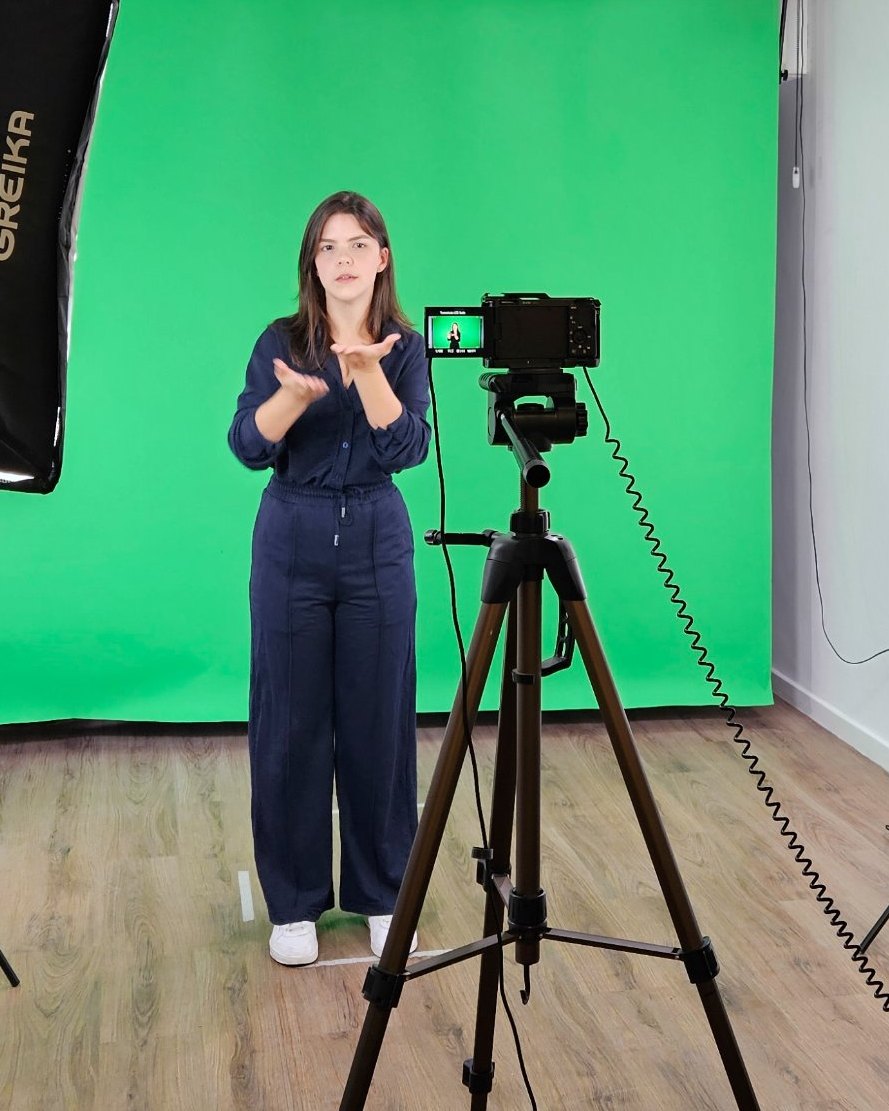
I work from my own studio, with a green screen and professional camera and audio equipment. I use it for remote interpreting and live streams.
In the same studio I record in-vision Libras translations from Portuguese, English and Spanish. I can deliver the signed recording on its own or the finished video with the interpreter in vision.
How I work
I work as part of a team. Assignments lasting more than an hour are covered by at least two interpreters working in rotation, as required by Brazilian Law No. 14,704/2023. Whenever possible, the team includes Deaf interpreters.
Where an event calls for it, I put together and coordinate the team and advise organisers on its size and the language combinations needed.
I don’t teach Libras: I refer requests for language classes to Deaf teachers.
Credentials
Member of APIC and ACATILS, with a postgraduate specialisation in Libras interpreting and Prolibras certification.
- 2024Member of APICThe Brazilian professional association of conference interpreters. APIC directory
- 2024Postgraduate specialisation in Libras InterpretingUniversidade Paulista (UNIP), Brazil.
- 2019
- 2015Prolibras certification in translation and interpretingNational proficiency examination run by Brazil’s National Institute for Deaf Education (INES) and the Federal University of Santa Catarina (UFSC).
Guidance for event organisers
What matters most when your event includes Libras.
Audience
Ask at registration who will be following the event in Libras, and say from the outset that interpreting will be provided: Deaf people only sign up when they know an event is for them too. If there are Deaf speakers or panellists, the team will also interpret from Libras into spoken Portuguese and will need a microphone.
Team
The size of the team depends on the length of the event, the number of rooms and the languages. Book a team that already works together, or let the coordinator put one together: interpreters who know each other give each other better support as they rotate. For international events, consider Deaf interpreters working into International Sign.
Languages
Tell the team which languages the speakers will use. If speakers will be presenting in English, the best option is a team that interprets directly between English and Libras; relay through Portuguese adds a step and increases the delay. If there is a spoken-language booth, the Libras team needs the same audio feed as the booth.
Materials
Send the programme, slides, proper names and acronyms. Don’t forget the things that tend to get left out: videos that will be shown, opening speeches read from a script, songs and poems. Unsubtitled video and text read aloud at speed are the hardest things to interpret without preparation.
Stage and lighting
The interpreter stands beside the speaker, in the same line of sight as the slides, with dedicated lighting and a plain background. When the room is darkened for a video, that light stays on. Reserve the front rows for those following in Libras and, if there are large screens, keep the interpreter in shot.
Streaming and recording
Say in advance whether the event will be streamed or recorded: the interpreter window needs its own camera, framing and background. The Brazilian standard ABNT NBR 15290 specifies a window at least half the height and a quarter of the width of the screen; any smaller and the signing cannot be read. Any later use of the recording must be covered in the contract, as it involves the interpreters’ image rights.
Lead time and budget
Libras cannot be left to the last minute: in many settings it is a legal requirement in Brazil, and it belongs in the budget alongside sound and staging. The earlier you get in touch, the better your chances of securing the right team for the languages and format of your event.
To check my availability, send me the date, languages, format, duration and city of the event.
Check availabilityFor audiovisual translation, send me the subject of the video, its length and your deadline.